
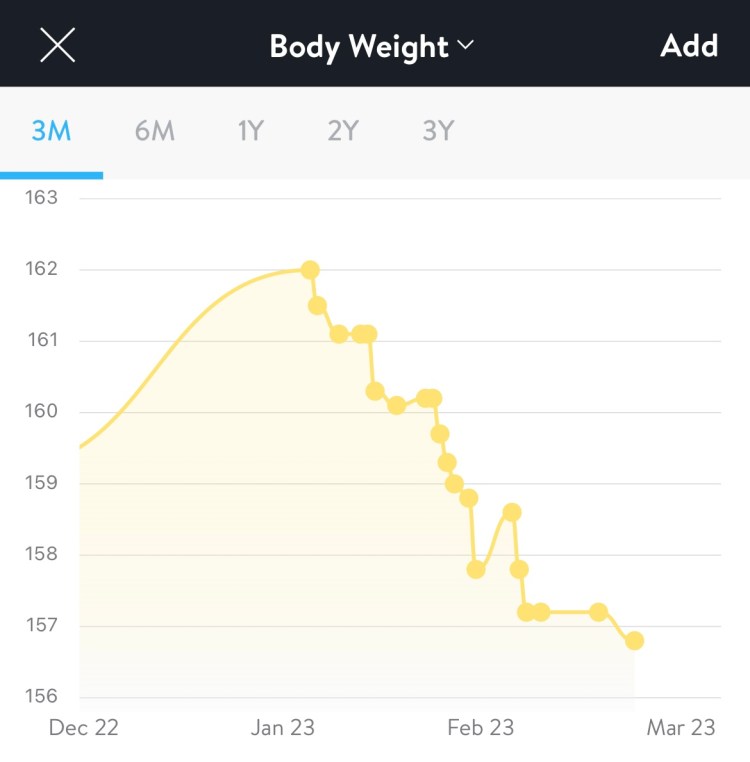
I’m down about 5 pounds since the start of the new year, and it’s due in large part to two factors: sticking pretty closely to the macros my trainer has set for me AND returning to intermittent fasting. I’m hoping to continue that downward trend you see in the graph to the left.
I jumped into intermittent fasting (IF) a few years ago without really knowing what I was doing. It seemed simple enough: ‘open’ your eating window for a few hours each day, and then when your eating window ends, stop eating until your window reopens. I started easy with a 14:10 schedule – 14 hours of fasting, followed by a 10 hour eating window. I would close my eating window for the day at 7pm, then fast from food until 9am the next day. After adapting to that schedule, I eventually moved to a 16:8 window, making my fast a little bit longer.
I’ve heard it described by people with way more credentials than me as an advanced dieting strategy. Maybe it is, but I found IF fairly easy to adapt to and it changed my relationship with food.
No more ‘good’ and ‘bad’ foods
I have labeled foods as being good or bad for as long as I can remember. There are certain foods I just see as fattening and indulgent, and others that are more fat-loss friendly. When I am trying to lose weight, it’s those fattening foods that I always crave, but I deemed them off-limits. With IF, they aren’t off-limits. As long as I am in my eating window, I could eat those foods. IF removed the ‘bad’ stigma. I no longer feel guilty for eating foods that are maybe not as healthy or fat-loss friendly. And by removing that stigma and giving myself permission, it somehow also took away the craving I had for them.
IF eliminated nighttime snacking
I used to grab a bowl of cereal before bed or munch on snack food while watching TV Typically, I’m not hungry in the evenings (or maybe I was before IF, if I was restricting my food during the day). But when I started IF, closing my window after dinner, I eliminated the habit of mindless, nighttime snacking. A 14 or 16 hour fasting window sounds like a long time, but most of the fasting window is spent sleeping, and eating enough during the day made it easy to break this nighttime snacking habit.
No need to count calories/macros… but you can still overeat when doing IF
My first time doing IF, I was burnt out from tracking calories and macros. The eating and fasting windows freed me from having to track everything. I lost 10-12 pounds the first 3-4 months following IF, but then my weight loss stalled. Looking back, I realize I was really maximizing my food intake during my eating window, consuming way more than I needed. I wasn’t re-gaining weight but I also wasn’t losing weight. That’s when I hired a coach. More on that to come in a future blog post…
I followed IF for almost a year the first time I did it. It’s a way of eating I could do forever, except I love breakfast food. I decided to return to IF again at the start of this year. Only this time, when I open my window, I’m eating breakfast food, no matter the time of day. Just another reason why IF works for me, because it gives me flexibility and freedom with my eating.
I mentioned macros, calories and tracking. That’s a post (or a series of posts) for another day. I think what I have appreciated most about intermittent fasting is the simplicity. It’s given me a way to ‘reset’ daily. I used to reward myself with ‘cheat’ meals for staying on plan and not indulging in foods I enjoy, but with IF, I can enjoy food without guilt or feeling like I’ve failed.
Have you tried intermittent fasting? If so, what do you like/dislike about it?
 CINDY DIEHL
I’ve been following intermittent fasting for a little over a year now and I absolutely love it! I’ve never felt soeto lose weight before.
Smith Justin Walker
LikeLike
I’ve tried intermittent fasting and it’s worked great for me. I’m not a morning person so the fasts are usually at night, but it’s easy to adapt to and I’ve lost weight without all the fuss.
LikeLike